
Chaos Wars is nobody's first game. It can't be. It wouldn't be. This is why it doesn't bother with a real tutorial. Why would it?
You have your first fight and the "tutorial" stops for story. By the next fight, you've forgotten that you are still in the tutorial, although this time the tutorial consists only of vague messages such as "two characters that fight together can team up" (probably not word for word but words are wasted on this game). Is this a problem? Is the game bad because it does not make itself accessible?
No. Accessibility is a design choice, not an issue of design competence. There's a philosophy that every game might be somebody's first, even if real life tells us that is logistically impossible. Nobody is going to play Flipside before Half-Life 2, for instance. But even if that distinction is false, there is something valuable in open accessibility for all players of a game. Super Mario Bros., for instance, isn't easy but it is accessible. You are the only identifiable being on the first screen and everything is oriented towards the right. You can't go left without hitting a wall. If you go right, the world begins to scroll and move and live. This is a fantastic model of accessibility because going right is the only point to the game and the complexity of the game comes in obstacles to going to the right.
Accessibility is important because it leads to understanding and playtime analysis. As soon as you can adequately access the systems of the game, you can begin to understand how these systems beget meaning.
Sometimes bridging the gap between accessibility and understanding is the central conceit to the game. Shiren the Wanderer, for instance, seems impossibly inaccessible upon first play due to all of the various roguelike systems within the game, but the heart of the game lies in analyzing how to properly exploit the various simple systems. As soon as the gap between accessibility and understanding is bridged, the game unfurls itself to you and your playstyle becomes the various ways in which you exploit the systems you have come to understand.
On the other hand, the gap between accessibility and understanding can be so short that proper play becomes intuition. I think the best example of this style of design lies in first-person shooters - a game like Doom has a very short accessibility gap (gun shoots object) and as such, gameplay becomes frantic and harrowing instantly. The best example for a board game would be Checkers. The grid layout creates defined and stark breaks for movement and movement for the various pieces is so limited that good games of Checkers are less about strategy and more about reaction. All pieces in Checkers are equal and move as such while all guns in Doom are directly related to fucking shit up. There's no questions of scope or scale and that's why the game is effective.
Being able to access and understand a game's various systems is central to proper analysis.
But I'm not ready to try that for Chaos Wars quite yet. It's early in the game and to be honest, even though I have a degree in English literature earned by analysis of things I have little to say about, I have very little to say about the language of this game.
Instead, allow me to share a story about the accessibility of SRPGs in general.
In my pre-grade school years, I had a lot of different obsessions, like boys do: dinosaurs, buildings, animals, books, games and space. I would read anything and dream for hours at a time as long as I had something in my hands.
When I say games, I don't necessarily mean videogames. I played videogames, sure, but my experience was, for the most part, limited to the hour of playtime I would get at the daycare until I was about 8. It was limited to playing Megaman 2 and the first level of Little Nemo: The Dream Master over and over again. I don't remember needing anything else.
I do remember going over to my grandmother's house to take out her Chinese Checkers set and just read the manual. And when I had the manual memorized, I would splay out the game in front of me and play against myself. When I became poor competition, I would rearrange the marbles in different ways and create new games for myself with no defined rules and without endings.
I loved analyzing how games work within themselves and then loved ripping those workings apart and building new ones even more. By the time videogame magazines revealed their existence to me, I was already interested in what makes a game work and what doesn't and as such, would read walkthroughs over and over again for games I didn't play.
My first experience with SRPGs came when I read through a walkthrough of Shining Force. Doing so was like a revelation to me - game elements had faces, real, in-game faces that talked. Playing different characters significantly changed the attack method because they were different people, robots and squids. It was everything I ever wanted, but a Genesis was out of reach so I settled for fake recess karate fights where each person was a different Shining Force character and that changed the way they would fake kick each other (except for the instance where I was for-real kicked in the head by somebody jumping off of some broken swings). It was all very thrilling. I was 7 at the time.
It wasn't until 11 or 12 that I actually sat down and played Shining Force. It wasn't the first SPRG that I played, but it was the first one I cared about. The game was set up on the square grid that is emblematic of the genre today, but I didn't know that at the time. All I knew is that I was kind-of playing chess where the pieces had names and families and dreams.
Because the game had such a strong similarity to the board game language I had already learned, the accessibility gap was short and I could concentrate on the names and faces that I had strived to understand when I was younger. The relationship between the gameplay and the scale that I had embraced before I actually played the game still hangs with me today when analyzing what I play.
This is why the actual accessibility of Chaos Wars is so bothersome. There is very little connection between the game system and the characters within it. The game wants to be character-based but the tutorial shows that every character moves and acts interchangably. If that is the case, then the system itself needs to have the small gap between accessibility and understanding that games such as Doom and Checkers have: an easy system begetting intense concentration. But because of its slavish devotion to the genre, Chaos Wars is too bloated with stats and items and status effects to do as such. By the time the tutorial was finished, I had collected 15 items that I still don't know what to do with. Perhaps I will use these elements later in the game, but for now I feel disconnected from the systems I am supposed to be exploring.
In the end, Chaos Wars is indicative of the accessibility of SRPGs in general. We have the Disgaeas and the Fire Emblems that do a pretty good job of embracing the complexity of systems management, but for each one of these game that stand as an outlier to tight game accessibility, there are a billion other SRPGs that don't learn from Doom and Checkers. Content is only added, never trimmed. Chaos Wars is the worst example of that fundamental SRPG disconnect between a complex system that unfurls itself like a particularly whimsical math problem and the simple system that allows for characterization and thematic aspirations (although that most often leads to stories about dragons falling in love with people, which is a different point).
When is the last time an SRPG played like a pop song? Brief and crunchy and properly punctuated? Where's the "You Really Got Me" of SRPGs?
Shouldn't a game as transparent about its motives and existence strive for something like that? Why doesn't it? This is why I keep going. Maybe I'll figure that out.
7.27.2008
7.17.2008
1.1 Playnotes
MINUTES:
0:00 - Game Start
0:02 - The intro video has some light boomin' beats and many flying character portraits. I don't know who these characters are or why I should be bothered with them. The game doesn't seem to worry about that either, since it offers names under the portraits with no other context.
0:04 - Basic introduction of the setting: there's a floating world above Japan connected by what looks like the 9/11 light pillar memorial.
0:06 - We are introduced to the main characters - Hyoma, Shizuka and Hayatemaru. They are all precocious and have anime hair.
0:07 - With no prompting, the game shifts to two other unrelated characters: a MOE girl being threatened by a man that is sure to be the nerdiest nazi I've ever seen.
0:08 - The game offers me a tutorial, but warns me that I need to read the manual anyway. More on this later. The MOE girl, now named Rin without provacation, is fighting some Wherther's Original-looking monsters in what must be a library south of the Mason-Dixon considering the fact that it has a total of 3 bookshelves (just kidding, Southerners (but seriously, though))
0:14 - The tutorial ends. I am no more educated. Hyoma from the intro is here now, for some reason. Long story short:
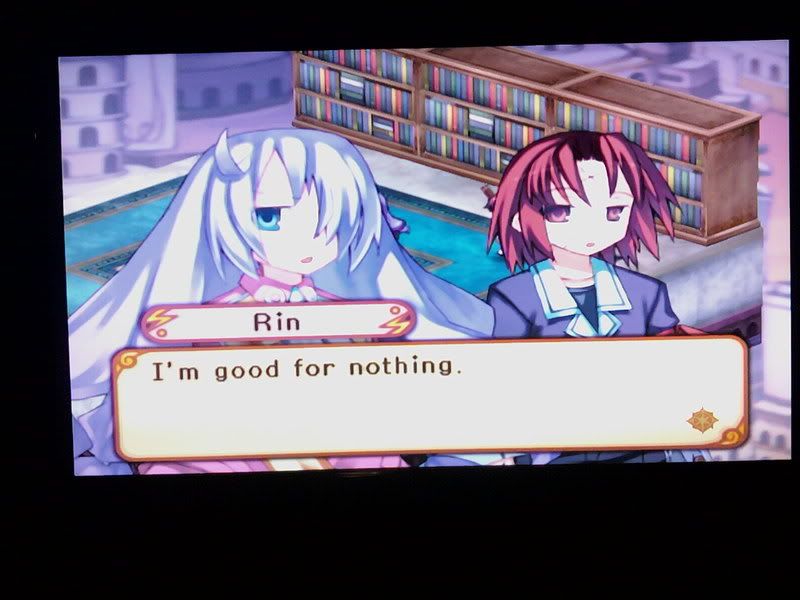
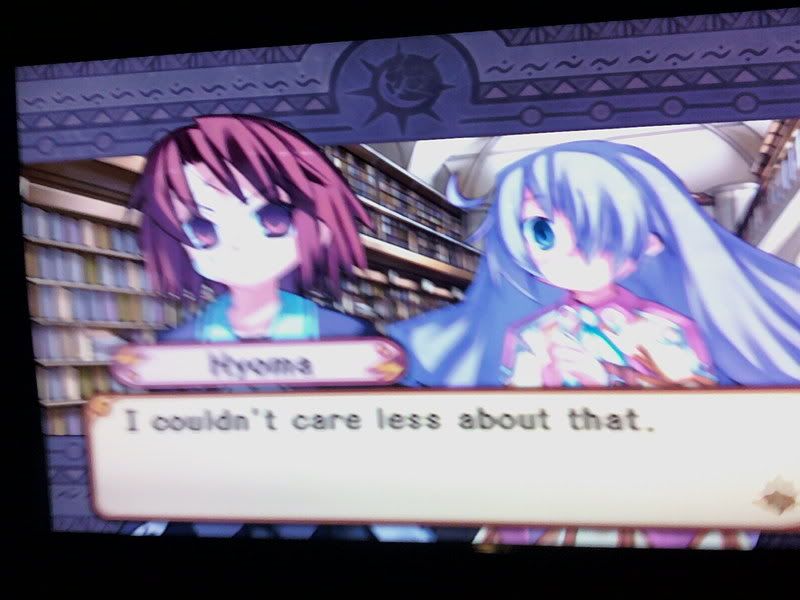
Sometime between this, a female knight with a scythe shows up.
0:19 - The second part of the tutorial starts. More on this later.
0:27 - The battle ends. Our heroes runs away to a beach somewhere away from the bad guys and end up at a house. They discuss whether or not to go in.
0:00 - Game Start
0:02 - The intro video has some light boomin' beats and many flying character portraits. I don't know who these characters are or why I should be bothered with them. The game doesn't seem to worry about that either, since it offers names under the portraits with no other context.
0:04 - Basic introduction of the setting: there's a floating world above Japan connected by what looks like the 9/11 light pillar memorial.
0:06 - We are introduced to the main characters - Hyoma, Shizuka and Hayatemaru. They are all precocious and have anime hair.
0:07 - With no prompting, the game shifts to two other unrelated characters: a MOE girl being threatened by a man that is sure to be the nerdiest nazi I've ever seen.
0:08 - The game offers me a tutorial, but warns me that I need to read the manual anyway. More on this later. The MOE girl, now named Rin without provacation, is fighting some Wherther's Original-looking monsters in what must be a library south of the Mason-Dixon considering the fact that it has a total of 3 bookshelves (just kidding, Southerners (but seriously, though))
0:14 - The tutorial ends. I am no more educated. Hyoma from the intro is here now, for some reason. Long story short:
Sometime between this, a female knight with a scythe shows up.
0:19 - The second part of the tutorial starts. More on this later.
0:27 - The battle ends. Our heroes runs away to a beach somewhere away from the bad guys and end up at a house. They discuss whether or not to go in.
7.03.2008
0.1 Secondhand Impressions
Before actually stepping into this mess, I felt obligated to play this thing with a good friend. I would be the observer and he the subject. His interest was peaked, but only until he actually sat down. I took notes for the one hour he played before he was insulted enough to lay his head in his hands and sigh. This may be light on content, but it was an interesting experience and I will share my notes here in fragments:
- quote from the in-game cinematics: "this story has no relation with any existing works". Friend responds with "really?"
-the game starts with 15 minutes of introduction to the story, which I will attempt to cover in my personal playthrough. Friend's impression: "These are dumb children that travel to a mystically dumb land"
-in-game tutorial starts, informing us that all of our actions will modify our WT number. the tutorial is not interested in letting us know what that means. at this point in time, the man who is playing says to me "this is emotionally draining"
-the in-game tutorial is interrupted by another 15 minutes of dialogue before segueing into another tutorial section. "This is hateful"
-By this point in time, the game has introduced us to 8 NPCs, each with the total speaking time of three minutes. Our impression: "this is less of a bad game and more of a bad play"
-When the save game option pops up in the middle of the conversation, Friend sets the controller on the endtable and sighs deeply. He looks up at me and wistfully announces, "you are retarded"
The game fought against our solidarity and we broke after an hour. We are still broken.
Next, I will play the game alone.
- quote from the in-game cinematics: "this story has no relation with any existing works". Friend responds with "really?"
-the game starts with 15 minutes of introduction to the story, which I will attempt to cover in my personal playthrough. Friend's impression: "These are dumb children that travel to a mystically dumb land"
-in-game tutorial starts, informing us that all of our actions will modify our WT number. the tutorial is not interested in letting us know what that means. at this point in time, the man who is playing says to me "this is emotionally draining"
-the in-game tutorial is interrupted by another 15 minutes of dialogue before segueing into another tutorial section. "This is hateful"
-By this point in time, the game has introduced us to 8 NPCs, each with the total speaking time of three minutes. Our impression: "this is less of a bad game and more of a bad play"
-When the save game option pops up in the middle of the conversation, Friend sets the controller on the endtable and sighs deeply. He looks up at me and wistfully announces, "you are retarded"
The game fought against our solidarity and we broke after an hour. We are still broken.
Next, I will play the game alone.
Subscribe to:
Comments (Atom)

