
3.23.2010
Quick Note: You Meet the Nicest People Making Games
So I'm sure that the very small number of readers here have already heard, but all-around good guy Spinach is making a documentary titled You Meet the Nicest People Making Games. If you have the means, please pledge here: http://kck.st/cRJcXC.
11.10.2009
3.2 On Numbers
Chaos Wars is, in a way, a form of abstract art.
All video games are. The fundamental basis of game creation is the ability to turn life into numbers. That's art. That's the beautiful type of honest abstraction that requires us to think about the way we live. You never think about how long you are going to live until you learn that most people only last until a certain age. If you are like me, you add that number of years to the year that you were born and carry that new number with you everywhere you go. It's just a number. And not a statistically viable number at that. But my own existential dread is tied to four-digit number and that's beautiful.
Despite the insistence of psychologists, philosophers and mathematicians, numbers by themselves are appealing because they are reliable. They are not abstract at all. Think about the way that you teach a child to count. You pour open a bag of M&Ms. It's so simple to illustrate - you give and take the pieces of candy away. Two becomes one after Dad eats a piece of candy. That's all it takes. If we thought that numbers were somehow unreliable, do you think money would exist? We turn time into money (figuratively) because nobody can (logically) argue that a one dollar represents anything more than a one dollar (on a purely numerative basis).
Do you see what I did there? I managed to undermine my entire point at the end of that paragraph by adding qualifiers. The stability of numbers is easily undermined by their application. Abstraction is the addition and subtraction of context. Ayn Rand's "A is A" statement means nothing when you talk to somebody that doesn't know the alphabet. A "slam dunk" means something completely different if you are talking to a tall guy that is amazing at basketball.
Video games have done well when it comes to making figures that act like people, despite the fact that anybody who plays a game is quite aware of how un-human games are. Uncharted tries to do it by having the protagonist's movements simulate that of a clumsy white man. Street Fighter does it by offering three different strengths of punching and kicking. That new UFC game has limb control mapped in a way that corresponds with limb placement on the body. When we play these games, the correspondence between character and real life is pretty direct. I am a clumsy white guy, so the figure in Uncharted takes on human characteristics to me. I can punch with different amounts of strength and so on. If my context as a player is to find some human characteristic in the numbers disguised as a person, these elements are abstract but relatable. I'm not literally swinging another person's arms or stumbling around, but it looks that way so that it feels more natural as an observer.
Of course, our experience as observers only allow us to look in as far as the game's frame is willing to extend. That's the difference between playing a video game and immersing yourself into some alternate reality (not possible technologically, but I've heard great things about drugs). The white guy from Uncharted walks in a way that seems relatable, but I have no idea whether or not he tastes grapefruit different than myself. Or if his knuckles have an ache or if it is more of a stinging pain when he is shooting bad guys on top of K2 (or wherever he is, man). I know him as a walker, a climber, a shooter because that is what I am capable of controlling. In the case of Uncharted, all the abstractions in the game exist to help me along in shooting and climbing and walking. The ability to disguise numbers as specific experiences is the fundamental strengths of games as a medium.
In the early days of video games, games were a bit more honest about the ways that numberjumbles were meant to be an abstraction of some type of real-life experience. Or maybe they were just less imaginative. Either way, people who have played games for a while seem to be comfortable with numbers. And why wouldn't they be? Numbers, either in accounting or Mario, are reliably representative. If you have three continues and need to continue once, then you will have two continues.
But like most things, games took numbers too far. These numbers were always meant to represent...something. But the gap between numbers and something has become far shorter. If an in a game like Gears of War drops an enemy's life points below the threshold required for that enemy to die in the game's logic, we don't literally see those numbers move, and we don't think about it unless we are a very particular type of person. More than likely, we shoot the monster in the head, watch the enemy drop and proceed to high-five whoever is sitting next to us. Developers ascribe numbers to human characteristics because they have no choice, but it certainly makes sense to try and cover that up. A lot of very good games do a great job of covering that up.
Of course, good games shouldn't feel obligated to cover that up. Take Shiren the Wanderer, for instance. In that game, your character gets hungry after too much physical activity. It's a neat idea, and serves well as a balancing tool for players that might want to touch every corner of every room in a game that is about surviving in a harsh environment. But it would be difficult to effectively represent hunger in a way that would mask the numbers as effectively as shooting someone is in Gears. So in Shiren, you can check your hunger number whenever you want and when that number gets low, you get a message that your stomach is grumbling. If you are hungry, you eat. If you don't eat, you die. It's pretty simple.
Since we know that Chaos Wars is not a good game, let's talk about the way that characters in Chaos Wars are assigned numbers. Each character in Chaos Wars has 17 different statistical categories. These statistical categories exist as numerical representations of aspects of that character's existence. Just for fun, let's assign these 17 statistical categories on a 1 to 10 scale to a character that is well-established outside of the game, Will Smith:
Hit Points: This represents the character's general health. Will Smith looks pretty healthy, so let's give him an 8.
Skill Points: Here's the first stumbling block. Skills represent your character's ability to interact with anything that can be interacted with in the game...which means that this is a numerical representative of a person's ability to do anything that they are capable of doing. Since I am ready to assume to Will Smith is capable of doing anything that Will Smith can do, he would probably have a 10 although I should note that characters in this game do have wildly varying skill points.
Special Gauge: To quote GameFAQs walkthrough author Georgi Samaras: "The special gauge starts at one and increases when a fighter takes damage or performs an action". I have no idea what that means or how it might be different from a skill point. Will Smith gets a 1, I guess.
I'm not going to keep up with this. I hope I've made my point. We all know who Will Smith is. But if he were a character in this game, there would be numbers assigned to characteristics that in no way help to identify or define him. You can argue that the manipulation of numbers in itself can be a game, and that is completely valid. But the manipulation of these numbers in a game like Chaos Wars is completely disconnected from what is actually going on while the game is being played. The numbers no longer remain abstract because they no longer represent anything. Characters in Chaos Wars increase in their mentality statistic, but there is no noticeable change to the expression of that character's intelligence. In real life, if Will Smith's body statistic dropped from an 8 to a 2, I'm pretty sure we would all notice.
Games won't stop with numbers anytime soon. Dragon Quest IX is a perfect example. When word got out that the traditionally numbers-based play would be replaced with a more active component, Japan collectively acted like it lost its keys. Apparently to people who play video games, the thrill of watching numbers that represent doing something is more engaging than actually doing something. And this isn't me slamming Japan either. Look at the popularity of fantasy football in the US. Or better yet, just try to get together enough people for a real football game.
I'm not arguing that numbers in games need to go away. But numbers existed in games as comfortable, stable and universal ways to represent ideas and concepts that are difficult to gamify (a word I may be but am probably not coining to mean the representation of a concept as an act of play). As game development has matured, the number of concepts that cannot be turned into an act of active play are slowly shrinking. We no longer need to settle for numbers that exist without real context. A game like Demon's Souls gets numbers. In Demon's Souls, the flux of numbers directly corresponds to the way that you play. The fondling has a purpose because you can feel it. An increase in your dexterity statistic means that your character noticeably moves faster when you press the button to do that. The way that games like Chaos Wars use numbers is an insult to the beautiful, glorious real math that makes up actual living. The numbers serve only to represent the things that aren't there, only for the sake of giving the player something to do. It is game slop. And for the sake of play, it needs to be cleaned up. Numbers in games may serve to represent real things, but games can't replace real life. They aren't meant to. Life and games skip hand-in-hand. We all play something.
All video games are. The fundamental basis of game creation is the ability to turn life into numbers. That's art. That's the beautiful type of honest abstraction that requires us to think about the way we live. You never think about how long you are going to live until you learn that most people only last until a certain age. If you are like me, you add that number of years to the year that you were born and carry that new number with you everywhere you go. It's just a number. And not a statistically viable number at that. But my own existential dread is tied to four-digit number and that's beautiful.
Despite the insistence of psychologists, philosophers and mathematicians, numbers by themselves are appealing because they are reliable. They are not abstract at all. Think about the way that you teach a child to count. You pour open a bag of M&Ms. It's so simple to illustrate - you give and take the pieces of candy away. Two becomes one after Dad eats a piece of candy. That's all it takes. If we thought that numbers were somehow unreliable, do you think money would exist? We turn time into money (figuratively) because nobody can (logically) argue that a one dollar represents anything more than a one dollar (on a purely numerative basis).
Do you see what I did there? I managed to undermine my entire point at the end of that paragraph by adding qualifiers. The stability of numbers is easily undermined by their application. Abstraction is the addition and subtraction of context. Ayn Rand's "A is A" statement means nothing when you talk to somebody that doesn't know the alphabet. A "slam dunk" means something completely different if you are talking to a tall guy that is amazing at basketball.
Video games have done well when it comes to making figures that act like people, despite the fact that anybody who plays a game is quite aware of how un-human games are. Uncharted tries to do it by having the protagonist's movements simulate that of a clumsy white man. Street Fighter does it by offering three different strengths of punching and kicking. That new UFC game has limb control mapped in a way that corresponds with limb placement on the body. When we play these games, the correspondence between character and real life is pretty direct. I am a clumsy white guy, so the figure in Uncharted takes on human characteristics to me. I can punch with different amounts of strength and so on. If my context as a player is to find some human characteristic in the numbers disguised as a person, these elements are abstract but relatable. I'm not literally swinging another person's arms or stumbling around, but it looks that way so that it feels more natural as an observer.
Of course, our experience as observers only allow us to look in as far as the game's frame is willing to extend. That's the difference between playing a video game and immersing yourself into some alternate reality (not possible technologically, but I've heard great things about drugs). The white guy from Uncharted walks in a way that seems relatable, but I have no idea whether or not he tastes grapefruit different than myself. Or if his knuckles have an ache or if it is more of a stinging pain when he is shooting bad guys on top of K2 (or wherever he is, man). I know him as a walker, a climber, a shooter because that is what I am capable of controlling. In the case of Uncharted, all the abstractions in the game exist to help me along in shooting and climbing and walking. The ability to disguise numbers as specific experiences is the fundamental strengths of games as a medium.
In the early days of video games, games were a bit more honest about the ways that numberjumbles were meant to be an abstraction of some type of real-life experience. Or maybe they were just less imaginative. Either way, people who have played games for a while seem to be comfortable with numbers. And why wouldn't they be? Numbers, either in accounting or Mario, are reliably representative. If you have three continues and need to continue once, then you will have two continues.
But like most things, games took numbers too far. These numbers were always meant to represent...something. But the gap between numbers and something has become far shorter. If an in a game like Gears of War drops an enemy's life points below the threshold required for that enemy to die in the game's logic, we don't literally see those numbers move, and we don't think about it unless we are a very particular type of person. More than likely, we shoot the monster in the head, watch the enemy drop and proceed to high-five whoever is sitting next to us. Developers ascribe numbers to human characteristics because they have no choice, but it certainly makes sense to try and cover that up. A lot of very good games do a great job of covering that up.
Of course, good games shouldn't feel obligated to cover that up. Take Shiren the Wanderer, for instance. In that game, your character gets hungry after too much physical activity. It's a neat idea, and serves well as a balancing tool for players that might want to touch every corner of every room in a game that is about surviving in a harsh environment. But it would be difficult to effectively represent hunger in a way that would mask the numbers as effectively as shooting someone is in Gears. So in Shiren, you can check your hunger number whenever you want and when that number gets low, you get a message that your stomach is grumbling. If you are hungry, you eat. If you don't eat, you die. It's pretty simple.
Since we know that Chaos Wars is not a good game, let's talk about the way that characters in Chaos Wars are assigned numbers. Each character in Chaos Wars has 17 different statistical categories. These statistical categories exist as numerical representations of aspects of that character's existence. Just for fun, let's assign these 17 statistical categories on a 1 to 10 scale to a character that is well-established outside of the game, Will Smith:
Hit Points: This represents the character's general health. Will Smith looks pretty healthy, so let's give him an 8.
Skill Points: Here's the first stumbling block. Skills represent your character's ability to interact with anything that can be interacted with in the game...which means that this is a numerical representative of a person's ability to do anything that they are capable of doing. Since I am ready to assume to Will Smith is capable of doing anything that Will Smith can do, he would probably have a 10 although I should note that characters in this game do have wildly varying skill points.
Special Gauge: To quote GameFAQs walkthrough author Georgi Samaras: "The special gauge starts at one and increases when a fighter takes damage or performs an action". I have no idea what that means or how it might be different from a skill point. Will Smith gets a 1, I guess.
I'm not going to keep up with this. I hope I've made my point. We all know who Will Smith is. But if he were a character in this game, there would be numbers assigned to characteristics that in no way help to identify or define him. You can argue that the manipulation of numbers in itself can be a game, and that is completely valid. But the manipulation of these numbers in a game like Chaos Wars is completely disconnected from what is actually going on while the game is being played. The numbers no longer remain abstract because they no longer represent anything. Characters in Chaos Wars increase in their mentality statistic, but there is no noticeable change to the expression of that character's intelligence. In real life, if Will Smith's body statistic dropped from an 8 to a 2, I'm pretty sure we would all notice.
Games won't stop with numbers anytime soon. Dragon Quest IX is a perfect example. When word got out that the traditionally numbers-based play would be replaced with a more active component, Japan collectively acted like it lost its keys. Apparently to people who play video games, the thrill of watching numbers that represent doing something is more engaging than actually doing something. And this isn't me slamming Japan either. Look at the popularity of fantasy football in the US. Or better yet, just try to get together enough people for a real football game.
I'm not arguing that numbers in games need to go away. But numbers existed in games as comfortable, stable and universal ways to represent ideas and concepts that are difficult to gamify (a word I may be but am probably not coining to mean the representation of a concept as an act of play). As game development has matured, the number of concepts that cannot be turned into an act of active play are slowly shrinking. We no longer need to settle for numbers that exist without real context. A game like Demon's Souls gets numbers. In Demon's Souls, the flux of numbers directly corresponds to the way that you play. The fondling has a purpose because you can feel it. An increase in your dexterity statistic means that your character noticeably moves faster when you press the button to do that. The way that games like Chaos Wars use numbers is an insult to the beautiful, glorious real math that makes up actual living. The numbers serve only to represent the things that aren't there, only for the sake of giving the player something to do. It is game slop. And for the sake of play, it needs to be cleaned up. Numbers in games may serve to represent real things, but games can't replace real life. They aren't meant to. Life and games skip hand-in-hand. We all play something.
11.07.2009
3.1 Playnotes
MINUTES:
1:22: After a few minutes, I get this message: "Mission complete!" I was on a mission this whole time?
1:23: ACTUAL DIALOG ALERT! Time Wizard: "Now we can use the summon function!" Protagonist: "Right, whatever that means."
1:25: Hubs in games are fantastic for killing tension and forward momentum. For those unfamiliar with the term, the different stages in a game are sometimes broken up by a hub area that allows you to interact with some ancillary features before choosing to continue to the next level. Chaos Wars, as it is apt to do, not only requires me to navigate a hub world, but I must also go to a computer to interact with a menu to choose which intangible key will open some intangible door. Using the imaginary key in the imaginary door menu allows me additional menu options in the level select. The whole experience makes me feel terrible.
1:27: The game allows you to take additional quests in addition to the linear progression. Out of some form of morbid curiosity (or extreme confusion), I choose a mission titled "Jelly Demon".
1:30: Our stern knight character hits a slime with a scythe, which increases her "mentality". When the next character kills that slime, that character increases in six different statistics. This type of unnecessary abstraction is one of the most egregiously senseless trends in video games and a fertile topic for future discussion.
1:46: There is a red sphere interface in the uppper-right hand corner during this battle. Right now there is one pie piece lit up. As the battle continues, the number of pie pieces stays constantly in flux. I have no idea what this means.
1:48: Killing slimes nets me a "Schoolboy's Uniform" and a "Young Devil's Horn". I know that it may seem a bit silly of me to expect logic out of the game's setting, but itemization in games is a constant source of consternation to me. I'll try to discuss this in the future.
1:51: This notes the first time that I've been hit since beginning this quest. Every enemy does zero damage.
1:54: I've finished the "Jelly Demon" quest. A menu informs me of this, as well as, for the first time, actually describing my goal in taking this quest. To quote, "Jelly Demon are getting together. Do something about it." If I hadn't gained the self-satisfaction gained from working earlier in the day, I would have probably attempted hanging myself from the despair gained by actively contributing to something so pointless. I had to settle for auto-erotic asphyxiation instead.
That said, although none of my characters took any damage during this quest, the quest classified as being "Rank 3" - which implies that this quest is at least more important than something else in the game by two entire ranks.
1:58: After this despicable experiment, I decided to continue the linear level progression. I'm playing a character who seems to be from another game, not that Chaos Wars bothers to let me know. This character is unique because his defensive skills allow me to engage in Quick-Time Events. This is the equivalent of going to your own birthday party hosted by some relatives that you don't like and learning that they've surprised you by bringing along the neighbors that keep stealing your newspaper.
2:00: I've discovered that the L2 & R2 buttons allow me to fast forward through all of the game's combat animations. Of course, a game developer should probably not create anything that any consumer would ever have the desire to fast-forward through but this feature will probably make playing Chaos Wars a bit more pleasurable. Unfortunately, L2 & R2 don't work as well as the eject button.
1:22: After a few minutes, I get this message: "Mission complete!" I was on a mission this whole time?
1:23: ACTUAL DIALOG ALERT! Time Wizard: "Now we can use the summon function!" Protagonist: "Right, whatever that means."
1:25: Hubs in games are fantastic for killing tension and forward momentum. For those unfamiliar with the term, the different stages in a game are sometimes broken up by a hub area that allows you to interact with some ancillary features before choosing to continue to the next level. Chaos Wars, as it is apt to do, not only requires me to navigate a hub world, but I must also go to a computer to interact with a menu to choose which intangible key will open some intangible door. Using the imaginary key in the imaginary door menu allows me additional menu options in the level select. The whole experience makes me feel terrible.
1:27: The game allows you to take additional quests in addition to the linear progression. Out of some form of morbid curiosity (or extreme confusion), I choose a mission titled "Jelly Demon".
1:30: Our stern knight character hits a slime with a scythe, which increases her "mentality". When the next character kills that slime, that character increases in six different statistics. This type of unnecessary abstraction is one of the most egregiously senseless trends in video games and a fertile topic for future discussion.
1:46: There is a red sphere interface in the uppper-right hand corner during this battle. Right now there is one pie piece lit up. As the battle continues, the number of pie pieces stays constantly in flux. I have no idea what this means.
1:48: Killing slimes nets me a "Schoolboy's Uniform" and a "Young Devil's Horn". I know that it may seem a bit silly of me to expect logic out of the game's setting, but itemization in games is a constant source of consternation to me. I'll try to discuss this in the future.
1:51: This notes the first time that I've been hit since beginning this quest. Every enemy does zero damage.
1:54: I've finished the "Jelly Demon" quest. A menu informs me of this, as well as, for the first time, actually describing my goal in taking this quest. To quote, "Jelly Demon are getting together. Do something about it." If I hadn't gained the self-satisfaction gained from working earlier in the day, I would have probably attempted hanging myself from the despair gained by actively contributing to something so pointless. I had to settle for auto-erotic asphyxiation instead.
That said, although none of my characters took any damage during this quest, the quest classified as being "Rank 3" - which implies that this quest is at least more important than something else in the game by two entire ranks.
1:58: After this despicable experiment, I decided to continue the linear level progression. I'm playing a character who seems to be from another game, not that Chaos Wars bothers to let me know. This character is unique because his defensive skills allow me to engage in Quick-Time Events. This is the equivalent of going to your own birthday party hosted by some relatives that you don't like and learning that they've surprised you by bringing along the neighbors that keep stealing your newspaper.
2:00: I've discovered that the L2 & R2 buttons allow me to fast forward through all of the game's combat animations. Of course, a game developer should probably not create anything that any consumer would ever have the desire to fast-forward through but this feature will probably make playing Chaos Wars a bit more pleasurable. Unfortunately, L2 & R2 don't work as well as the eject button.
10.02.2009
Quick Note
Unbeknownst to me, I guess people have actually been reading this thing. Hello Maryland! Thanks Dess!
This thing probably looks like it is dead. It's not. I'm not done with this thing. I'm going to ride it straight to hell. I've been caught up with work. I won't be so caught up quite soon.
Until then, feel free to contact me at jacobmunford AT gmail DOT com. If you've got something you'd like to say to me, I'd love to hear from you. I'm much less bitter when I'm not talking about things that depress me. I promise.
This thing probably looks like it is dead. It's not. I'm not done with this thing. I'm going to ride it straight to hell. I've been caught up with work. I won't be so caught up quite soon.
Until then, feel free to contact me at jacobmunford AT gmail DOT com. If you've got something you'd like to say to me, I'd love to hear from you. I'm much less bitter when I'm not talking about things that depress me. I promise.
2.22.2009
2.2 on Tone
Chaos Wars does not deserve to take that tone with me.
The game has a lot of dialog that is an excellent representation of problems of tone in video games. When two of the protagonists of this game who are defined by their friendship are reintroduced after being separated, they proceed to bicker as if they have been married for 15 years and are having financial problems. The noble knight character, otherwise stoic, confides to our moronic lead boy that she doesn't deserve to enjoy life.
I don't know how it got this bad. I'm not sure when it became acceptable for games to become nihilistic pools of life-disaffirming garbage. If half the things that characters in this game said came out of the mouths of people that I know, I'd be in jail for repeated ritualistic murder.
The real problem is, I do know how we got here.
At some point in time, somebody who made games (probably somebody at Square, to be honest), decided that the best way to make a game feel epic was to assign plotting and dialog duties to middle-school teenagers in the middle of math class. That's how the Playstation-era was littered with Japanese RPG pap like Final Fantasy VII (yeah, it was Square) and its numerous children. Too many games during this time are about overly-upset people fighting versions of their parents that are dragons or robots or something. The more that a game resembled the unwatchable anime of the late-80s and early-90s, the better it sold (and was scored!). This sort of entertainment is deliberately created to impress a feeling of importance and significance by emoting, no matter how ineffectual said emoting really is.
These games are remembered fondly because they were different than what came before, and I suppose I can understand that. They weren't functionally entertaining, but they stood out.
What I can't understand is why games carried the tone established by these games like a goddamned banner across an infinite bridge. The only people that video games have left to impress upon are the ones that are really smart or really fucking dumb! Average people have some sort of experience with video games, either an understanding or emotion involved with them. The business plan worked! People know that this stuff exists! Teenagers play games (also, they always have! That's what sex in high school is all about). Even more significantly, the people that played games as teenagers are still playing games, even though they have become bankers, teachers and convicted sex criminals! People just enjoying playing good games, and it doesn't matter if they come in the form of cards or a jigsaw puzzle or a board game or Sonic the Hedgehog.
The problem is that the tone has never changed. And that tone is a kudzu vine that is strangling games around the throat and dragging them down into the cesspools of artistic hell.
Here's the facts, in a numbered list:
Games still feel the need to impress, even though there's nobody important left to impress. The Wii pretty much icepicked that rotting farmhouse door.
Good games will impress because they are good games, ie: fun to play and interesting. Kinda like how people say that songs have a good beat.
Most video game narratives are sub-pulp, misanthropic piles of sludge that reek of desperation and a need to be accepted as important.
Games need to get their swagger back. They need to cut back on their aspirations to appeal to people who buy paperback sci-fi novels when they are lonely. And they need to start reveling in their gameness. The best tone that a game can strike is a confident one.
Games like Gears of War 2 are infinitely playable because they are willing to throw everything up on the counter with the swagger of a diabetic biker gang member. Horde mode says “here's the game, strangle yourself with a necktie if you don't like it.”
The problem is that games are still growing, and are ill-equipped to truly feel EPIC in any way other than their play mechanics. Games like Gears 2 and Street Fighter can almost achieve that feeling because you are in full control of the faculties of the game. You are the game and the way you play is the narrative. Developers with the balls to make games like this are saying that they are so confident that their game is good, they trust that even the average homeless TVA victim can't screw it up.
And that's the right tone.
Shining Force is the only strategy RPG to assert this tone, if only because there is so little to do. After the first 15 minutes, there is almost nothing else to the game other than moving on a grid and not fucking up. That's pure game, baby.
The problem is that Chaos Wars can't ever say the same. It can't stand up on its own two legs, so it is propped up by misplaced emotion and sheer avarice. Idea Factory is hoping that you'll sit through the bullshit so that you can see your favorite whatevers do whatever to each other. And of course, since they aren't your favorite whatevers, there are a billion numbers to play with. Hopefully, that is enough for you to throw your 40 dollars on the table. It doesn't matter if dunk tank works, since you've already bought the baseballs. And now the fat wet clown on the sitting above the tank is calling YOU a faggot.
People who play games have been that kid at the dunk tank for too long. And I think it's time to come back to the same dunk tank with a molotov cocktail and a baseball bat. It may be too late to get our money back, but we can make some change out of the sad grinning obese clown that took it in the first place.
9.28.2008
2.1 Playnotes
MINUTES:
0:28: Radiance Island is the setting, which sounds promising. That sounds like a place where fun things may be happening to somebody.
0:29: Rin, precocious loli wizard, offers to give me a tutorial if I beg (what?). Hyoma, the angry protagonist, insults her for giving me a tutorial on features that are not available to me. This is turning into a cacophony of inter-game hate speech. The music is not bad, a little jangly.
0:30: The knight with a scythe, who seems have some shred of nobility, is laboring on about the house we have made a base out of and how large it is. "There are so many rooms!" She says. I can't leave the one I'm in.
0:32: I find an encyclopedia that promises to explain the me the plot of this game. Apparently, "He's a spirit thing called a devil master made from Janice's evilness" is an excellent introduction to a newcomer. This is all very strange, like the game was programmed from notes written on the back page of a middle school yearbook.
0:34: The encyclopedia informs me that the protagonist, a young boy who was curious about the cave behind his grandfather's house, has a special ability described as "a false god's judgment to punish the orignial sins of every living thing." More on this later.
0:35: The game catches me off-guard with some slightly clever writing: "it can attack an enemy by summoning things like weapons, protection devices, items, magazines, game software, coins found behind the couch, a half-empty cup of soda, etc.". I'm hoping to see the whole of Radiance Island flooded with IUDs and haypennies.
0:39: Playing with the inventory reveals that my character can wear two different pairs of boots. Itemization as a play mechanic may be an important topic of discussion for the future.
0:42: The previously noble and stoic knight attempts to elicit...something when she tells the protagonist "I don't deserve to enjoy life." More on this later, as well.
0:46: I'm still in a tutorial, apparently.
0:55: All characters have a skill called "Realize" that makes them actually effective, but only for three turns. At any other time, the characters do enough damage so that the enemies will regain their health by the next turn. There is also no penalty for activating this skill, so essentially, the game has turned actually playing the game into a play mechanic. If this were Kojima, I'm sure I'd appreciate it, but somehow I don't think this is intentional.
1:04: I have regained the protagonist's best friend, a young boy in a large scarf. Both characters agree to join up to get home or save the world (choose one!), but not after slinging very hateful barbs for about three minutes. Again, more on this later.
1:07: Although the tutorial is rather poor (How do my enemies continually regain their health?), the game encourages me to "Don't waste your time worrying about things you don't know." If a board game took the same tone with me, I would physically strike it.
1:17: After killing a human miltiaman, I receive an item called a cicada exoskeleton. This seems to be the case for all militiamen. Again, itemization may be an interesting topic in the future.
1:19: I finish killing all of the miltiamen, each equipped with a sword. I am rewarded with pieces of wood (items called "incomplete stick"s). Swords are not wood, and if they are, then this is a poor miltia. Again, itemization discussion seems prudent.
7.27.2008
1.2 On Accessibility: Doom and Checkers
Chaos Wars is nobody's first game. It can't be. It wouldn't be. This is why it doesn't bother with a real tutorial. Why would it?
You have your first fight and the "tutorial" stops for story. By the next fight, you've forgotten that you are still in the tutorial, although this time the tutorial consists only of vague messages such as "two characters that fight together can team up" (probably not word for word but words are wasted on this game). Is this a problem? Is the game bad because it does not make itself accessible?
No. Accessibility is a design choice, not an issue of design competence. There's a philosophy that every game might be somebody's first, even if real life tells us that is logistically impossible. Nobody is going to play Flipside before Half-Life 2, for instance. But even if that distinction is false, there is something valuable in open accessibility for all players of a game. Super Mario Bros., for instance, isn't easy but it is accessible. You are the only identifiable being on the first screen and everything is oriented towards the right. You can't go left without hitting a wall. If you go right, the world begins to scroll and move and live. This is a fantastic model of accessibility because going right is the only point to the game and the complexity of the game comes in obstacles to going to the right.
Accessibility is important because it leads to understanding and playtime analysis. As soon as you can adequately access the systems of the game, you can begin to understand how these systems beget meaning.
Sometimes bridging the gap between accessibility and understanding is the central conceit to the game. Shiren the Wanderer, for instance, seems impossibly inaccessible upon first play due to all of the various roguelike systems within the game, but the heart of the game lies in analyzing how to properly exploit the various simple systems. As soon as the gap between accessibility and understanding is bridged, the game unfurls itself to you and your playstyle becomes the various ways in which you exploit the systems you have come to understand.
On the other hand, the gap between accessibility and understanding can be so short that proper play becomes intuition. I think the best example of this style of design lies in first-person shooters - a game like Doom has a very short accessibility gap (gun shoots object) and as such, gameplay becomes frantic and harrowing instantly. The best example for a board game would be Checkers. The grid layout creates defined and stark breaks for movement and movement for the various pieces is so limited that good games of Checkers are less about strategy and more about reaction. All pieces in Checkers are equal and move as such while all guns in Doom are directly related to fucking shit up. There's no questions of scope or scale and that's why the game is effective.
Being able to access and understand a game's various systems is central to proper analysis.
But I'm not ready to try that for Chaos Wars quite yet. It's early in the game and to be honest, even though I have a degree in English literature earned by analysis of things I have little to say about, I have very little to say about the language of this game.
Instead, allow me to share a story about the accessibility of SRPGs in general.
In my pre-grade school years, I had a lot of different obsessions, like boys do: dinosaurs, buildings, animals, books, games and space. I would read anything and dream for hours at a time as long as I had something in my hands.
When I say games, I don't necessarily mean videogames. I played videogames, sure, but my experience was, for the most part, limited to the hour of playtime I would get at the daycare until I was about 8. It was limited to playing Megaman 2 and the first level of Little Nemo: The Dream Master over and over again. I don't remember needing anything else.
I do remember going over to my grandmother's house to take out her Chinese Checkers set and just read the manual. And when I had the manual memorized, I would splay out the game in front of me and play against myself. When I became poor competition, I would rearrange the marbles in different ways and create new games for myself with no defined rules and without endings.
I loved analyzing how games work within themselves and then loved ripping those workings apart and building new ones even more. By the time videogame magazines revealed their existence to me, I was already interested in what makes a game work and what doesn't and as such, would read walkthroughs over and over again for games I didn't play.
My first experience with SRPGs came when I read through a walkthrough of Shining Force. Doing so was like a revelation to me - game elements had faces, real, in-game faces that talked. Playing different characters significantly changed the attack method because they were different people, robots and squids. It was everything I ever wanted, but a Genesis was out of reach so I settled for fake recess karate fights where each person was a different Shining Force character and that changed the way they would fake kick each other (except for the instance where I was for-real kicked in the head by somebody jumping off of some broken swings). It was all very thrilling. I was 7 at the time.
It wasn't until 11 or 12 that I actually sat down and played Shining Force. It wasn't the first SPRG that I played, but it was the first one I cared about. The game was set up on the square grid that is emblematic of the genre today, but I didn't know that at the time. All I knew is that I was kind-of playing chess where the pieces had names and families and dreams.
Because the game had such a strong similarity to the board game language I had already learned, the accessibility gap was short and I could concentrate on the names and faces that I had strived to understand when I was younger. The relationship between the gameplay and the scale that I had embraced before I actually played the game still hangs with me today when analyzing what I play.
This is why the actual accessibility of Chaos Wars is so bothersome. There is very little connection between the game system and the characters within it. The game wants to be character-based but the tutorial shows that every character moves and acts interchangably. If that is the case, then the system itself needs to have the small gap between accessibility and understanding that games such as Doom and Checkers have: an easy system begetting intense concentration. But because of its slavish devotion to the genre, Chaos Wars is too bloated with stats and items and status effects to do as such. By the time the tutorial was finished, I had collected 15 items that I still don't know what to do with. Perhaps I will use these elements later in the game, but for now I feel disconnected from the systems I am supposed to be exploring.
In the end, Chaos Wars is indicative of the accessibility of SRPGs in general. We have the Disgaeas and the Fire Emblems that do a pretty good job of embracing the complexity of systems management, but for each one of these game that stand as an outlier to tight game accessibility, there are a billion other SRPGs that don't learn from Doom and Checkers. Content is only added, never trimmed. Chaos Wars is the worst example of that fundamental SRPG disconnect between a complex system that unfurls itself like a particularly whimsical math problem and the simple system that allows for characterization and thematic aspirations (although that most often leads to stories about dragons falling in love with people, which is a different point).
When is the last time an SRPG played like a pop song? Brief and crunchy and properly punctuated? Where's the "You Really Got Me" of SRPGs?
Shouldn't a game as transparent about its motives and existence strive for something like that? Why doesn't it? This is why I keep going. Maybe I'll figure that out.
You have your first fight and the "tutorial" stops for story. By the next fight, you've forgotten that you are still in the tutorial, although this time the tutorial consists only of vague messages such as "two characters that fight together can team up" (probably not word for word but words are wasted on this game). Is this a problem? Is the game bad because it does not make itself accessible?
No. Accessibility is a design choice, not an issue of design competence. There's a philosophy that every game might be somebody's first, even if real life tells us that is logistically impossible. Nobody is going to play Flipside before Half-Life 2, for instance. But even if that distinction is false, there is something valuable in open accessibility for all players of a game. Super Mario Bros., for instance, isn't easy but it is accessible. You are the only identifiable being on the first screen and everything is oriented towards the right. You can't go left without hitting a wall. If you go right, the world begins to scroll and move and live. This is a fantastic model of accessibility because going right is the only point to the game and the complexity of the game comes in obstacles to going to the right.
Accessibility is important because it leads to understanding and playtime analysis. As soon as you can adequately access the systems of the game, you can begin to understand how these systems beget meaning.
Sometimes bridging the gap between accessibility and understanding is the central conceit to the game. Shiren the Wanderer, for instance, seems impossibly inaccessible upon first play due to all of the various roguelike systems within the game, but the heart of the game lies in analyzing how to properly exploit the various simple systems. As soon as the gap between accessibility and understanding is bridged, the game unfurls itself to you and your playstyle becomes the various ways in which you exploit the systems you have come to understand.
On the other hand, the gap between accessibility and understanding can be so short that proper play becomes intuition. I think the best example of this style of design lies in first-person shooters - a game like Doom has a very short accessibility gap (gun shoots object) and as such, gameplay becomes frantic and harrowing instantly. The best example for a board game would be Checkers. The grid layout creates defined and stark breaks for movement and movement for the various pieces is so limited that good games of Checkers are less about strategy and more about reaction. All pieces in Checkers are equal and move as such while all guns in Doom are directly related to fucking shit up. There's no questions of scope or scale and that's why the game is effective.
Being able to access and understand a game's various systems is central to proper analysis.
But I'm not ready to try that for Chaos Wars quite yet. It's early in the game and to be honest, even though I have a degree in English literature earned by analysis of things I have little to say about, I have very little to say about the language of this game.
Instead, allow me to share a story about the accessibility of SRPGs in general.
In my pre-grade school years, I had a lot of different obsessions, like boys do: dinosaurs, buildings, animals, books, games and space. I would read anything and dream for hours at a time as long as I had something in my hands.
When I say games, I don't necessarily mean videogames. I played videogames, sure, but my experience was, for the most part, limited to the hour of playtime I would get at the daycare until I was about 8. It was limited to playing Megaman 2 and the first level of Little Nemo: The Dream Master over and over again. I don't remember needing anything else.
I do remember going over to my grandmother's house to take out her Chinese Checkers set and just read the manual. And when I had the manual memorized, I would splay out the game in front of me and play against myself. When I became poor competition, I would rearrange the marbles in different ways and create new games for myself with no defined rules and without endings.
I loved analyzing how games work within themselves and then loved ripping those workings apart and building new ones even more. By the time videogame magazines revealed their existence to me, I was already interested in what makes a game work and what doesn't and as such, would read walkthroughs over and over again for games I didn't play.
My first experience with SRPGs came when I read through a walkthrough of Shining Force. Doing so was like a revelation to me - game elements had faces, real, in-game faces that talked. Playing different characters significantly changed the attack method because they were different people, robots and squids. It was everything I ever wanted, but a Genesis was out of reach so I settled for fake recess karate fights where each person was a different Shining Force character and that changed the way they would fake kick each other (except for the instance where I was for-real kicked in the head by somebody jumping off of some broken swings). It was all very thrilling. I was 7 at the time.
It wasn't until 11 or 12 that I actually sat down and played Shining Force. It wasn't the first SPRG that I played, but it was the first one I cared about. The game was set up on the square grid that is emblematic of the genre today, but I didn't know that at the time. All I knew is that I was kind-of playing chess where the pieces had names and families and dreams.
Because the game had such a strong similarity to the board game language I had already learned, the accessibility gap was short and I could concentrate on the names and faces that I had strived to understand when I was younger. The relationship between the gameplay and the scale that I had embraced before I actually played the game still hangs with me today when analyzing what I play.
This is why the actual accessibility of Chaos Wars is so bothersome. There is very little connection between the game system and the characters within it. The game wants to be character-based but the tutorial shows that every character moves and acts interchangably. If that is the case, then the system itself needs to have the small gap between accessibility and understanding that games such as Doom and Checkers have: an easy system begetting intense concentration. But because of its slavish devotion to the genre, Chaos Wars is too bloated with stats and items and status effects to do as such. By the time the tutorial was finished, I had collected 15 items that I still don't know what to do with. Perhaps I will use these elements later in the game, but for now I feel disconnected from the systems I am supposed to be exploring.
In the end, Chaos Wars is indicative of the accessibility of SRPGs in general. We have the Disgaeas and the Fire Emblems that do a pretty good job of embracing the complexity of systems management, but for each one of these game that stand as an outlier to tight game accessibility, there are a billion other SRPGs that don't learn from Doom and Checkers. Content is only added, never trimmed. Chaos Wars is the worst example of that fundamental SRPG disconnect between a complex system that unfurls itself like a particularly whimsical math problem and the simple system that allows for characterization and thematic aspirations (although that most often leads to stories about dragons falling in love with people, which is a different point).
When is the last time an SRPG played like a pop song? Brief and crunchy and properly punctuated? Where's the "You Really Got Me" of SRPGs?
Shouldn't a game as transparent about its motives and existence strive for something like that? Why doesn't it? This is why I keep going. Maybe I'll figure that out.
7.17.2008
1.1 Playnotes
MINUTES:
0:00 - Game Start
0:02 - The intro video has some light boomin' beats and many flying character portraits. I don't know who these characters are or why I should be bothered with them. The game doesn't seem to worry about that either, since it offers names under the portraits with no other context.
0:04 - Basic introduction of the setting: there's a floating world above Japan connected by what looks like the 9/11 light pillar memorial.
0:06 - We are introduced to the main characters - Hyoma, Shizuka and Hayatemaru. They are all precocious and have anime hair.
0:07 - With no prompting, the game shifts to two other unrelated characters: a MOE girl being threatened by a man that is sure to be the nerdiest nazi I've ever seen.
0:08 - The game offers me a tutorial, but warns me that I need to read the manual anyway. More on this later. The MOE girl, now named Rin without provacation, is fighting some Wherther's Original-looking monsters in what must be a library south of the Mason-Dixon considering the fact that it has a total of 3 bookshelves (just kidding, Southerners (but seriously, though))
0:14 - The tutorial ends. I am no more educated. Hyoma from the intro is here now, for some reason. Long story short:
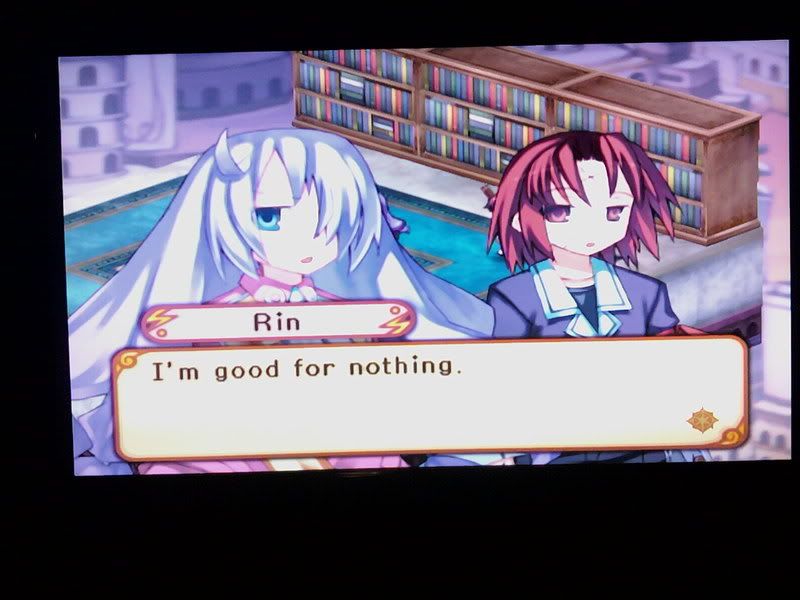
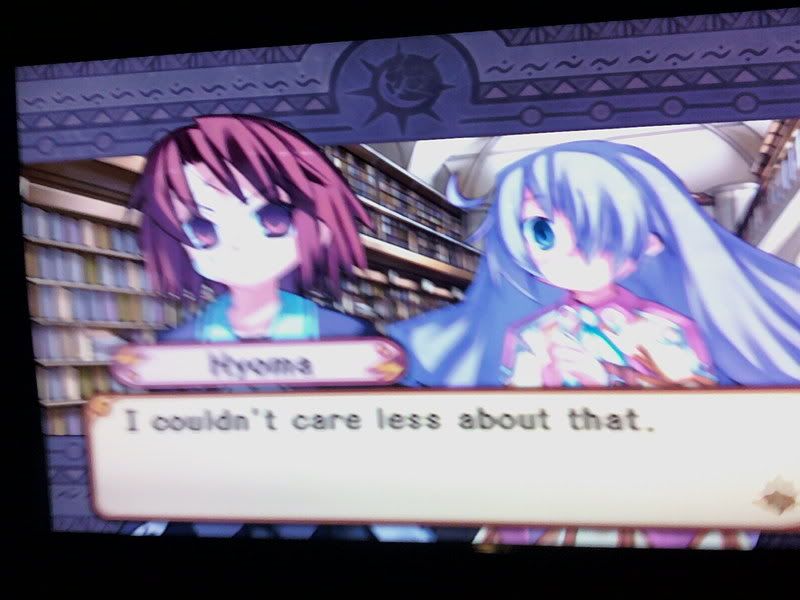
Sometime between this, a female knight with a scythe shows up.
0:19 - The second part of the tutorial starts. More on this later.
0:27 - The battle ends. Our heroes runs away to a beach somewhere away from the bad guys and end up at a house. They discuss whether or not to go in.
0:00 - Game Start
0:02 - The intro video has some light boomin' beats and many flying character portraits. I don't know who these characters are or why I should be bothered with them. The game doesn't seem to worry about that either, since it offers names under the portraits with no other context.
0:04 - Basic introduction of the setting: there's a floating world above Japan connected by what looks like the 9/11 light pillar memorial.
0:06 - We are introduced to the main characters - Hyoma, Shizuka and Hayatemaru. They are all precocious and have anime hair.
0:07 - With no prompting, the game shifts to two other unrelated characters: a MOE girl being threatened by a man that is sure to be the nerdiest nazi I've ever seen.
0:08 - The game offers me a tutorial, but warns me that I need to read the manual anyway. More on this later. The MOE girl, now named Rin without provacation, is fighting some Wherther's Original-looking monsters in what must be a library south of the Mason-Dixon considering the fact that it has a total of 3 bookshelves (just kidding, Southerners (but seriously, though))
0:14 - The tutorial ends. I am no more educated. Hyoma from the intro is here now, for some reason. Long story short:
Sometime between this, a female knight with a scythe shows up.
0:19 - The second part of the tutorial starts. More on this later.
0:27 - The battle ends. Our heroes runs away to a beach somewhere away from the bad guys and end up at a house. They discuss whether or not to go in.
7.03.2008
0.1 Secondhand Impressions
Before actually stepping into this mess, I felt obligated to play this thing with a good friend. I would be the observer and he the subject. His interest was peaked, but only until he actually sat down. I took notes for the one hour he played before he was insulted enough to lay his head in his hands and sigh. This may be light on content, but it was an interesting experience and I will share my notes here in fragments:
- quote from the in-game cinematics: "this story has no relation with any existing works". Friend responds with "really?"
-the game starts with 15 minutes of introduction to the story, which I will attempt to cover in my personal playthrough. Friend's impression: "These are dumb children that travel to a mystically dumb land"
-in-game tutorial starts, informing us that all of our actions will modify our WT number. the tutorial is not interested in letting us know what that means. at this point in time, the man who is playing says to me "this is emotionally draining"
-the in-game tutorial is interrupted by another 15 minutes of dialogue before segueing into another tutorial section. "This is hateful"
-By this point in time, the game has introduced us to 8 NPCs, each with the total speaking time of three minutes. Our impression: "this is less of a bad game and more of a bad play"
-When the save game option pops up in the middle of the conversation, Friend sets the controller on the endtable and sighs deeply. He looks up at me and wistfully announces, "you are retarded"
The game fought against our solidarity and we broke after an hour. We are still broken.
Next, I will play the game alone.
- quote from the in-game cinematics: "this story has no relation with any existing works". Friend responds with "really?"
-the game starts with 15 minutes of introduction to the story, which I will attempt to cover in my personal playthrough. Friend's impression: "These are dumb children that travel to a mystically dumb land"
-in-game tutorial starts, informing us that all of our actions will modify our WT number. the tutorial is not interested in letting us know what that means. at this point in time, the man who is playing says to me "this is emotionally draining"
-the in-game tutorial is interrupted by another 15 minutes of dialogue before segueing into another tutorial section. "This is hateful"
-By this point in time, the game has introduced us to 8 NPCs, each with the total speaking time of three minutes. Our impression: "this is less of a bad game and more of a bad play"
-When the save game option pops up in the middle of the conversation, Friend sets the controller on the endtable and sighs deeply. He looks up at me and wistfully announces, "you are retarded"
The game fought against our solidarity and we broke after an hour. We are still broken.
Next, I will play the game alone.
6.25.2008
what is all this?
Chaos Wars
Developed by Idea Factory
Published by O3 Entertainment
Made for the Playstation2
Featuring copyrights from Idea Factory, Aruze, Atlus and RED Entertainment
Available only at Gamestop
Played by the hopeless
Chaos Wars is a videogame. It was originally released in Japan in 2006. That should have been enough.
However, O3 Entertainment took it upon themselves to translate and release this game in the West. I won't go into why this is important. Other people have said it better, such as internet robopresario Tollmaster on internet video game forum selectbutton.net:
Chaos Wars is a crossover game - meaning that the game's appeal comes in characters and ideas from other games. This concept is not uncommon in entertainment. It means that significance within the game comes from the symbolic value of characters outside the game. Chaos Wars features characters from video game companies such as Idea Factory, Aruze, Atlus and RED Entertainment.
This blog is about playing Chaos Wars.
Here's why that is not good.
I care about video games.
I care about art.
People, especially people on the internet, argue about when and how and if games will become art. When Roger Ebert suggested that games are not art, internet game forums created list upon list that could be shot out of cannons at the Ebert home.
There can be no debate - Chaos Wars is not art.
Chaos Wars is not even artistic.
Chaos Wars is not even entertainment.
Chaos Wars is base, hateful stuff. Chaos Wars is the best example of industrial malfeasance in the name of video games. It is the most direct and stark example of what is wrong with underdog media. It makes me want to take my copies of Mario Bros. 3 and Shadow of the Colossus and Deception 2 and Sound Voyager and throw them into Lake Michigan, drive away and join the army.
This blog is about playing Chaos Wars.
This game features characters from Shadow Hearts, Growlanser, Blazing Souls, Gakuen Toshi Vara Noir, Spectral Force, Spectral Souls, Hametsu No Mars, Gungrave and Shinsengumi Gunraw Den. I haven't played any of these games, other than Gungrave. You probably haven't played any of these games, other than Gungrave. Half of these games are not available in the West. The games that have been released in the West are niche JRPGs released by companies like Xseed and Nippon Ichi.
This game was localized by O3 Entertainment, an incredibly small American publisher. Their prior successes include localizing Chaos Field and almost localizing Radirgy GeneriC, two not very good shooters for the Gamecube. If you have heard anything about Chaos Wars, you have heard about the low quality of the English translation. It was splashed about Kotaku and other such websites with youtube videos galore, such as this one:
Again, to quote internet guy Tollmaster from his posts on selectbutton.net:
WHO IS THIS GAME FOR?
Who will enjoy this?
Who will take the effort to play this game?
Who could have possibly preordered it?
This is the most insular game ever released on Western shores. Hardcore sims like PTO II and Romance of the Three Kingdoms, despite their hardcore stat-based obtuseness, have been enjoyed by somebody's dad who has a real job as a banker. I've borne witness!
This blog is about playing Chaos Wars.
I am going to play this game in full, taking it as seriously as it wants me to take it. I will play as often as I can and post the results. My writing will vary wildly and possibly be a weak imitation of Tim Rogers-esque writing, at times.
Somebody has to play this game to see what happened.
If you care about video games, you know why.
We are responsible.
Charles Johnson, the author of Middle Passage, once said:
"whatever the work is, whatever the book is, whatever the product is, it's something that we interject into the public space. it's a public act. it's our human expression, and we are responsible for all our forms of human expression, all our deeds and actions, of which art is one. the artist has a tremendous degree of responsibility"
the observers of art have a responsibility as well, especially when the artists have been so irresponsible.
we must explore it
we must figure it out
we are responsible
this blog is about playing chaos wars
Developed by Idea Factory
Published by O3 Entertainment
Made for the Playstation2
Featuring copyrights from Idea Factory, Aruze, Atlus and RED Entertainment
Available only at Gamestop
Played by the hopeless
Chaos Wars is a videogame. It was originally released in Japan in 2006. That should have been enough.
However, O3 Entertainment took it upon themselves to translate and release this game in the West. I won't go into why this is important. Other people have said it better, such as internet robopresario Tollmaster on internet video game forum selectbutton.net:
1. It's a strategy RPG by Idea Factory, which is in and of itself an already fucktarded, hardheaded decision on the part of anyone. Strategy RPGs are already a niche genre--RPGs themselves have only recently started to gain respect in the mainstream, and strategy RPGs are a genre that caters to a specific hardcore subset of that genre...Idea Factory games are one step further: they work unlike any other company's games, and then proceed to hide their workings behind obtuse and obscure menus and commands. .. Idea Factory is almost synonymous with "bad, lazy games."...Chaos Wars is a strategy RPG, an incredibly insular genre. These are games focused on numbers-based everythings: numbers that determine how much each character is capable of moving in order to engage in numbers-based combat in order to decrease the numbers of the enemy. To manage your characters, you open menus which display spreadsheets upon spreadsheets of statistics and tweak them infinitesimally. Even the best strategy RPGs often resemble accounting textbooks.
3. The cast selection is batshit insane, in the best, worst way possible...this compilation of characters features far, far, far more obscure characters, from relatively niche and small companies, featuring characters that almost no one is familiar with and whom only an infinitesimal section of the population are actually familiar with. In many cases, even the niche companys' most popular characters are unrepresented, leaving even more obscure characters in their place.
Chaos Wars is a crossover game - meaning that the game's appeal comes in characters and ideas from other games. This concept is not uncommon in entertainment. It means that significance within the game comes from the symbolic value of characters outside the game. Chaos Wars features characters from video game companies such as Idea Factory, Aruze, Atlus and RED Entertainment.
This blog is about playing Chaos Wars.
Here's why that is not good.
I care about video games.
I care about art.
People, especially people on the internet, argue about when and how and if games will become art. When Roger Ebert suggested that games are not art, internet game forums created list upon list that could be shot out of cannons at the Ebert home.
There can be no debate - Chaos Wars is not art.
Chaos Wars is not even artistic.
Chaos Wars is not even entertainment.
Chaos Wars is base, hateful stuff. Chaos Wars is the best example of industrial malfeasance in the name of video games. It is the most direct and stark example of what is wrong with underdog media. It makes me want to take my copies of Mario Bros. 3 and Shadow of the Colossus and Deception 2 and Sound Voyager and throw them into Lake Michigan, drive away and join the army.
This blog is about playing Chaos Wars.
This game features characters from Shadow Hearts, Growlanser, Blazing Souls, Gakuen Toshi Vara Noir, Spectral Force, Spectral Souls, Hametsu No Mars, Gungrave and Shinsengumi Gunraw Den. I haven't played any of these games, other than Gungrave. You probably haven't played any of these games, other than Gungrave. Half of these games are not available in the West. The games that have been released in the West are niche JRPGs released by companies like Xseed and Nippon Ichi.
This game was localized by O3 Entertainment, an incredibly small American publisher. Their prior successes include localizing Chaos Field and almost localizing Radirgy GeneriC, two not very good shooters for the Gamecube. If you have heard anything about Chaos Wars, you have heard about the low quality of the English translation. It was splashed about Kotaku and other such websites with youtube videos galore, such as this one:
Again, to quote internet guy Tollmaster from his posts on selectbutton.net:
This game, already insular and hateful by its nature and very existence, is only available through Gamestop. And considering the fact that the inventory of any Gamestop is determined through the amount of preorder sales, this is a game that may not be available in your local store unless somebody preordered Chaos Wars.
There's not much more I can say, other than I don't believe that this was an honest attempt. No. No fucking way. More likely, O~3 Entertainment is a company about having balls, pure and simple. The job interview involves pulling down your pants and getting your scrotum weighed to see if you've got what it takes. How did Chaos Wars happen? We'll never know. Maybe it was a bet. Maybe someone LOST a bet. Maybe the director got drunk. Maybe they're really big Gungrave and Shadow Hearts fans over there. Whatever the reason, they went balls-out with something anyone else, anyone sane, would quickly have deemed unreasonable to do, and they fucking did it with the worst voice acting ever. It's the biggest "fuck you" to the games industry since Metal Gear Solid 2. O~3 don't care about your logic or rules, it does what it wants, whenever the fuck it wants to.
Quite simply, if Metal Gear Solid 2 was the first post-modern game, then the English translation of Chaos Wars has ushered in the era of post-post-modernism, a brave new world where machismo is the only standard men may be measured by. O~3 wanted Chaos Wars over here, and it stuffed that game about cute anime girls right down the industry's throat until it choked
WHO IS THIS GAME FOR?
Who will enjoy this?
Who will take the effort to play this game?
Who could have possibly preordered it?
This is the most insular game ever released on Western shores. Hardcore sims like PTO II and Romance of the Three Kingdoms, despite their hardcore stat-based obtuseness, have been enjoyed by somebody's dad who has a real job as a banker. I've borne witness!
This blog is about playing Chaos Wars.
I am going to play this game in full, taking it as seriously as it wants me to take it. I will play as often as I can and post the results. My writing will vary wildly and possibly be a weak imitation of Tim Rogers-esque writing, at times.
Somebody has to play this game to see what happened.
If you care about video games, you know why.
We are responsible.
Charles Johnson, the author of Middle Passage, once said:
"whatever the work is, whatever the book is, whatever the product is, it's something that we interject into the public space. it's a public act. it's our human expression, and we are responsible for all our forms of human expression, all our deeds and actions, of which art is one. the artist has a tremendous degree of responsibility"
the observers of art have a responsibility as well, especially when the artists have been so irresponsible.
we must explore it
we must figure it out
we are responsible
this blog is about playing chaos wars
Subscribe to:
Comments (Atom)

